Photostability testing in cosmetics under ICH Q1B: avoid degradation and losses. Discover why the 3mm rule and the choice of primary packaging are critical to avoiding syneresis and ANMAT inhibition sanctions. We analyze the ICH Q1B standard, the use of chemical actinometry, and reference laboratories in Argentina (ALS, Melacrom, SGS, CEPRO) to guarantee the commercial success of your premium formulas.
Brands delayed launches due to photochemical stability failures (EU)
A documented case: A European brand spent 14 months preparing a new SPF moisturizer, but a GMP auditor detected that the 6 months of accelerated stability at 40°C did not justify the 24-month shelf life printed on the label.
Result: Launch delayed by 4 months.
The technical problem was as follows:
- The stability data presented did not support the minimum durability.
- The brand treated stability as a “checklist” rather than scientific evidence.
- The auditor demanded immediate correction before commercialization.
Massive PAO (Period After Opening) failures due to lack of evidence
The majority of European brands print 12M / 24M without real data to support it. This has become a recurring problem in DGCCRF inspections and PIF (Product Information File) reviews.
What is failing:
- Brands assume that because “it always worked,” the PAO is valid.
- They fail to present physical-chemical or microbiological data.
- This can lead to market recalls.
Other brands that “pass” accelerated stability but fail in real life
A recent case presented a report: “3 months accelerated 40°C/75% RH — PASS,” but the emulsion was broken upon opening the sample: separation, rancid odor, loss of integrity.
Why this occurs:
- The accelerated protocol is poorly designed.
- The Q10 factor does not apply equally to complex emulsions.
- Some emulsions are more stable at 40°C than at 25°C → false positives.
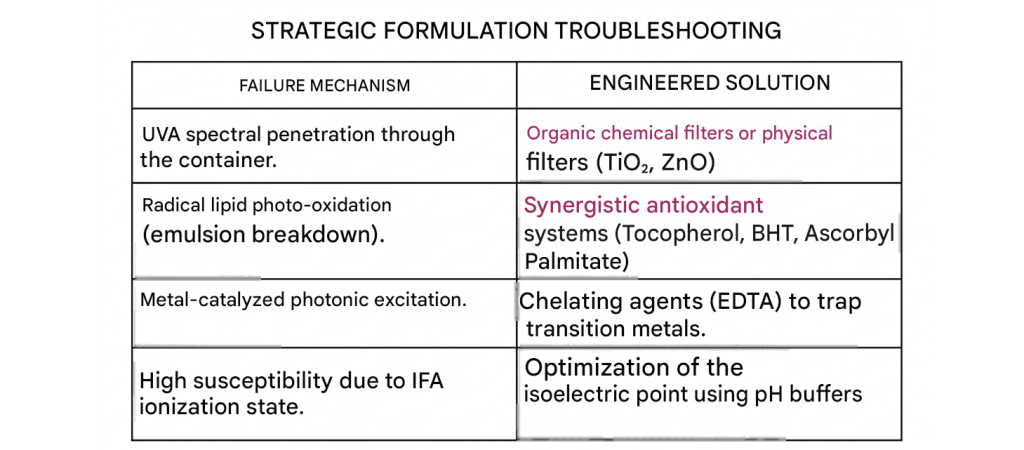
Brands are failing in photostability for 4 reasons:
- Underestimating the degradation of UVA filters (avobenzone, octinoxate).
- Poorly designed accelerated protocols (misapplied Q10).
- Failure to justify PAO or real durability (insufficient evidence).
- Using cold-process emulsions without interfacial stability.
Real Consequences:
- Launch delays.
- Mandatory reformulations.
- Failed GMP audits.
- Risk of market recall.
- Loss of regulatory credibility.
For a cosmetic chemist, the ICH Q1B guideline is not a mere regulatory compliance formality, but a physical and chemical roadmap to protect the integrity of a formulation against electromagnetic radiation. The values of 1.2 million lux-hours of visible light and 200 watt-hours per square meter (Wh/m²) of near-ultraviolet (UVA) radiation constitute the global gold standard due to a perfect scientific calibration between quantum physics and commercial reality.
The scientific and mathematical basis for these figures is presented below, aimed at formulators and cosmetic chemists:
1. The physics of units: What are we actually measuring?
Visible light: The basis for the 1.2 million lux-hours figure
- The unit: The lux measures illuminance—that is, the luminous flux incident on a surface, weighted according to human eye sensitivity (the photopic vision curve, which peaks at 555 nm). One lux is equivalent to one lumen per square meter.
- Accumulation: The lux-hour is a unit of cumulative exposure (Illuminance × Time).
- Commercial shelf-life mathematics:
- Standard lighting in pharmacy, perfumery, or supermarket displays ranges from 1,000 to 1,500 lux.
- If a cosmetic product is continuously exposed to 1,000 lux of light for 24 hours a day, it will take 1,200 hours to reach the threshold established by the ICH Q1B guideline. This equates to exactly 50 continuous days.
- Under real-world commercial conditions (where stores are open and lights are on for 10 to 12 hours a day), that 1.2 million lux-hour figure represents approximately 3 to 4 months of direct exposure at the point of sale.
- If the product is placed near a shop window or an outdoor display area, where average indirect daylight is around 5,000 lux, it will reach the test dosage in just 240 hours (about 10 days of actual exposure).
- Scientific conclusion: Exposure to 1.2 million lux-hours provides a controlled acceleration of the visible light stress that an average cosmetic product would undergo during its entire commercial display period prior to consumer purchase. ### Ultraviolet light: The basis for the 200 Wh/m² figure
- The unit: Unlike the lux, watt-hours (Wh) do not depend on human eye perception; they measure actual physical energy. 200 Wh/m² is equivalent to 720,000 joules of energy per square meter (72 J/cm²) striking the formulation in the near-ultraviolet range (320 to 400 nm). * The 320 nm threshold (Why not use UVB?): The standard requires filters that eliminate any radiation below 320 nm. The reason is purely practical: UVB photons (290–320 nm) possess so much energy that they would break apart almost any organic molecule (causing artificial degradation that would never occur indoors). Under real-world conditions, window glass and packaging plastics completely absorb UVB radiation. UVA radiation (320–400 nm), on the other hand, has high penetrating power and easily passes through windows and most clear plastic or glass packaging.
- The thermodynamics of photolysis: UVA photons possess energy ranging from 3.1 to 3.9 eV. This energy is thermodynamically sufficient to:
- Excite conjugated double bonds in organic dyes and sunscreens, causing discoloration.
- Generate free radicals by breaking weak bonds in oils and lipids, initiating rancidity (photo-oxidation).
- Excite fragrances (such as terpenes) and photosensitive vitamins (such as retinol or vitamin C), negating the product’s promised efficacy.
2. The “Golden Ratio”: The spectral balance of sunlight
A brilliant aspect of the ICH Q1B standard is that the ratio between 1.2 million lux-hours and 200 Wh/m² is not an arbitrary figure; It is an exact replica of the energy balance of daylight.
- In natural solar radiation reaching the Earth’s surface (represented by the international daylight standard D65 or ID65), the physical ratio between visible illuminance and UV energy is practically constant.
- When sunlight naturally delivers 1.2 million lux-hours of visible illumination to an object, the amount of accompanying ultraviolet energy within that same spectrum is approximately 200 Wh/m².
- The standard’s safeguard: By requiring both limits to be measured using calibrated sensors (or chemical actinometry with quinine), the standard prevents a laboratory from evaluating a product using unbalanced artificial light sources (such as common household lamps, which emit plenty of visible light but lack the UV spectrum). The test is valid only if the product has withstood exposure to both minimum stress thresholds. ## 3. The moment of realization for the formulating chemist
Understanding the physics behind these figures allows the cosmetic chemist to design using a comprehensive risk management approach: - The tinted glass myth: Many chemists package photosensitive serums in blue or green glass bottles, believing they are protected. From a physical standpoint, blue glass absorbs yellow and red visible wavelengths but is highly permeable to high-energy visible blue light and UVA radiation (320-
In the competitive B2B cosmetic industry, guaranteeing a product’s shelf life is not just a regulatory requirement. It is also an inescapable commitment to quality and consumer safety. In Argentina, photostability trials have consolidated as a critical pillar in formulation development, allowing brands to predict how their products (and packaging) will react to light exposure during commercialization and use.
What do photostability tests involve in Argentina?
In Argentina, photostability tests align with the international guidelines of the ICH Q1B Guide, adopted by ANMAT. The primary objective is to demonstrate that exposure to visible and ultraviolet light does not cause unacceptable changes in the quality of the cosmetic.
For a study to be valid and representative, photostability chambers must subject samples to rigorous minimum doses:
- Visible light: An exposure of no less than 1.2 million lux-hours.
- Ultraviolet Light (UVA): An integrated energy of at least 200 watt-hours per square meter.
To achieve these values, laboratories use light sources that simulate standard daylight, or a simultaneous combination of cool white fluorescent lamps and near-UV lamps.
Photostability testing for cosmetics: Regulatory framework and exposure requirements
Although requirements for conventional cosmetics may be more flexible than for prescription drugs, the protocol demands comprehensive evaluations. The process is designed considering the interaction of light with the formulation and packaging material:
- Period After Opening (PAO): Photostability also influences the PAO declaration. To simulate real use, laboratories open the products and re-close them before subjecting them to storage and light tests, validating declarations that usually range between six months and two years.
- Packaging Compatibility and Hierarchical Approach: Tests can be performed on the bulk cosmetic or in its final packaging. If evaluated in the commercial packaging, the shelf-life test is combined simultaneously with packaging compatibility. It determines if the primary container (bottle, tube, jar) adequately protects the formula against photonic degradation.
- Quality Parameters to Evaluate: After light exposure, it is verified that the product meets its specifications through tests for color, odor, appearance, viscosity, pH, specific gravity, and weight loss. Critical factors for microbiological safety, such as the efficacy of the preservative system and microbial limits, are also evaluated.
- Over-the-Counter (OTC) Cosmetics: Certain products, such as sunscreens or vitamin creams, are subject to much higher standards. In these cases, active validation of the active ingredient assay is required before starting the study, and tests must be performed under both accelerated and real-time conditions.
If you are looking for companies that perform testing in Argentina
Here are some companies in Argentina and globally that can carry out these tests, which require advanced technological infrastructure and quality accreditations (such as GLP or ISO 17025):
- ALS Global: This international company has a presence in Argentina and possesses state-of-the-art photostability chambers. They are capable of performing controlled exposures of up to 1.8 million lux-hours in compliance with ICH guidelines. They specialize in shelf-life testing, packaging compatibility, and PAO trials for cosmetics and OTC products.
- Laboratorio Melacrom: Located in Mercedes, it is an internationally accredited laboratory (ISO 17025 and GLP) specializing in high-complexity analysis. They offer comprehensive services for the cosmetic sector, including on-going and accelerated stability studies in their own climatic chambers, as well as quantification of impurities and active ingredients using advanced equipment such as HPLC and LC-MS/MS.
- SGS Argentina: Offers research programs and stability studies under controlled temperature and humidity. They operate under strict cGMP standards to ensure the safety of pharmaceutical and cosmetic substances throughout their life cycle.
- CEPROCOR: The Center for Excellence in Products and Processes of Córdoba acts as a regional technological reference. They offer high-complexity analytical infrastructure to execute stability studies oriented toward the personal care and health industry.
How do I choose between flat or spherical sensors for my laboratory?
To choose between both types of sensors for your photostability chamber under the ICH Q1B standard, the decision comes down to physical precision versus mathematical calculation:
Spherical Sensors (Recommended for maximum precision):
- Real 3D Measurement: They measure real physical radiation from all directions in space, including scattered light and light reflected from below.
- No Angular Errors: Since light always hits perpendicularly (at 90°) at some point on the sphere, they do not suffer from “cosine error.” This eliminates the need for software corrections and avoids over-irradiating samples, ensuring automatic shutdown at the exact time.
Flat Sensors (Require calibration and mathematical correction):
- Approximate Calculation: They do not measure real radiation directly but calculate it mathematically.
- Reading Limitation: They only see light coming from one hemisphere (from above), ignoring radiation arriving at very oblique angles or reflected from below.
- Risk of Overexposure: They suffer from “cosine error” according to Lambert’s law. If the sensor lacks a calibrated cosine correction, it will underestimate the real energy received by the samples, unnecessarily prolonging the test and potentially generating false positives.
How is quinine actinometry validated?
The validation of quinine actinometry is performed by measuring the change in absorbance (ΔA) of a standard solution after exposure, compared to a control protected from light.
Procedure and Acceptance Criteria:
- Preparation and Exposure: A 2% w/v aqueous solution of quinine monohydrate hydrochloride is used. 1 cm quartz cells (or 20 ml colorless ampoules) are filled, with some exposed (AT) and others protected with aluminum foil (AO) alongside the samples.
- Measurement: The absorbance of both solutions is determined at 400 nm using a spectrophotometer.
- Validation Calculation (ΔA = AT − AO): For the photostability test to be certified as valid before ANMAT or global authorities, a minimum change must be reached:
- ≥ 0.9 for Option 1 light sources (Xenon / D65/ID65 spectrum).
- ≥ 0.5 for Option 2 light sources (combination of fluorescent lamps).
Which antioxidants are most effective for preventing photolysis?
To prevent photolysis and halt the lipid auto-oxidation cascade (especially that initiated by UVA radiation), the most effective antioxidants are free radical scavengers:
- Tocopherol (Vitamin E).
- BHT (Butylated Hydroxytoluene).
- Ascorbyl Palmitate (Lipophilic Vitamin C).
To guarantee their efficacy, these compounds must be incorporated in concentrations validated through prior compatibility studies with the formulation.
How is a dissolution profile performed after photo-exposure?
After subjecting the finished product to light exposure under the ICH Q1B standard, the dissolution profile is performed as follows:
- Representative Preparation: For oral solid dosage forms, the dissolution analysis must be carried out using a composite sample of appropriate size, typically 20 tablets or capsules, to ensure that the analyzed fraction is representative of the entire exposed lot.
- Comparative and Validated Analysis: The dissolution test is executed using duly validated analytical methods. This trial must be performed simultaneously on samples exposed to light and their respective “dark controls” (samples wrapped in aluminum foil and subjected to the same environment) to distinguish if physical alteration is due to temperature or photolysis.
- Acceptance Criterion (ANMAT/ICH): It is determined that a “significant change” (stability failure) has occurred if the product does not meet the specified dissolution acceptance criteria for 12 dosage units.
Don’t settle for reading the news.
Access the intelligence that allows you to create it.
Join the Private Circle and become part of B2B Market Intelligence.