


An innovative postbiotic cosmetic ingredient to reduce redness after external stress and improve skin elasticity. We’ll tell you all about it in this article.
In an often overwhelming world, there is something comforting about using traditional, tried-and-tested ingredients in our daily lives. The evident and perceptible effect of a product will make a comforting ritual, whether external or internal, passed down from generation to generation.
This also applies to the fermented milk drink kefir, famous worldwide for its beneficial health effects. Regular consumption of kefir is not only beneficial for our digestive system but also strengthens the immune system through various bioactive peptides and exopolysaccharides produced during the fermentation process, preserving an internal balance that helps us withstand external influences more easily.
With kefir’s rich history in mind, CLR has fused ancient kefir tradition with cutting-edge biotechnology to develop a revolutionary active ingredient that maintains skin in oxidative balance. CefiraProtect CLR™ is an innovative vegan fermented skincare ingredient based on a lysate of Lactobacillus kefiranofaciens, the primary bacteria in kefir grains that produce the high-value ingredient kefiran.
By utilizing these bacteria during the fermentation process, kefir’s balancing power can be translated into a supportive effect for the skin, all on a vegan basis. Cultivating these milk-loving bacteria in a plant-based manner is anything but straightforward.
For many decades, CLR has been recognized for its exceptional expertise in fermentation processes, especially in the preservation of plant lysates. These so-called postbiotics are known for their high efficacy, bioavailability, and tolerability in skincare applications.
Based on this extensive knowledge, CLR has undertaken the difficult task of enabling an organism to produce valuable nutrients outside its biological comfort zone.
Our skin and exposomes
When we’re outside our comfort zone, we’re constantly faced with various external factors that challenge both our well-being and our skin. These negative influences, such as UV radiation, stress, environmental pollution, insufficient sleep, and poor diet, are collectively known as the exposome—a set of conditions to which everyone is inevitably exposed.
As broad and comprehensive as these influences may seem, they actually affect the skin at the cellular level by stimulating the formation of free radicals, highly reactive molecules that can cause potential skin damage.
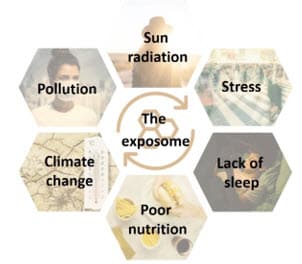
Fig. 1: External factors, summarized under the term exposome, that can have a negative effect on the condition of the skin.
Cellular self-defense against free radicals
The skin is incredibly intelligent and is normally able to neutralize these free radicals, provided this process occurs when the skin is in oxidative balance. However, oxidative balance cannot be maintained if external stressors accumulate and the balance tips toward oxidative stress. Once the skin’s own antioxidant potential is depleted, it needs to rely on its own self-protection so that it can once again fulfill its true purpose of acting as our body’s first barrier and subsequently maintain its healthy, radiant appearance.
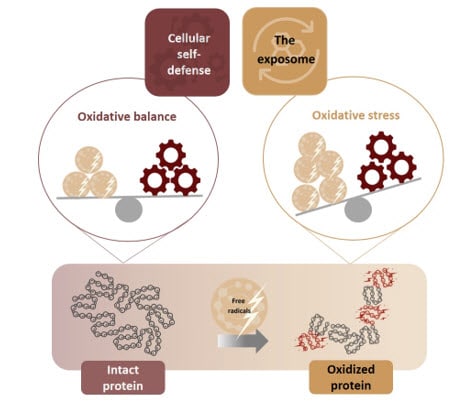
Fig. 2 The skin’s own cellular self-defense mechanism for maintaining oxidative balance is depleted as soon as external factors from the exposome accumulate and cause oxidative stress. As a result, the skin’s own proteins become oxidized, and their structure and functionality are altered.
Biomolecules, such as proteins that suffer oxidative stress in the skin—primarily collagen, keratin, elastin, and enzymes, among many others—oxidize uncontrollably, which can change their three-dimensional structure in such a way that their biological functionality is impaired.
This can lead to skin irritation, a weakened barrier, loss of elasticity and firmness, and, overall, compromised skin that cannot function properly. With CefiraProtect CLR™, the skin’s own self-defense mechanisms are enhanced, resulting in the restoration of oxidative balance and protein protection in all skin layers and, therefore, improved skin quality and resilience.
Enhancing the skin’s natural antioxidant potential, which allows it to protect and repair itself, can also be considered part of a broader holistic approach: the exposure to exposomes won’t change, but the skin’s response will.
Protection against protein oxidation in all layers of the skin
To visualize the effect of CefiraProtect CLR™ at the cellular level, human skin explants were stressed with UV-A radiation to such an extent that free radical formation was stimulated, leading to oxidative damage to proteins. These proteins can be visualized by fluorescence detection under an epifluorescence microscope.
The more intense the fluorescence signal, the higher the concentration of oxidized proteins after UV-A irradiation. In untreated skin, the skin resembles a blazing fire. The elevated oxidative damage is especially evident in the stratum corneum and at the dermal-epidermal junction.
The dermis, where collagen and elastin are found, also shows high levels of oxidized proteins. When the explant is treated with CefiraProtect CLR™, this “oxidative fire” does not occur. Proteins are protected in all layers of the skin by significantly reducing free radical formation.
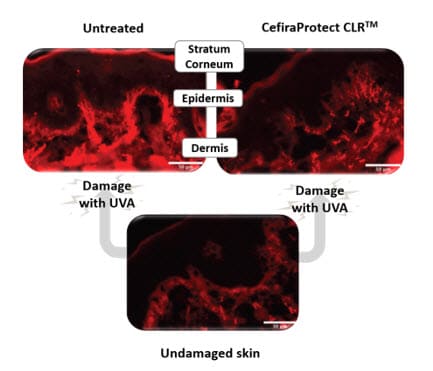
Fig. 3: In situ visualization of deep protein oxidation in human skin explants following UV-A radiation.
An exposome simulation study of how skin calms down faster to come back stronger
Subsequently, in vivo experiments were performed to confirm that CefiraProtect CLR™ was able to enhance skin recovery after exposure to exposome-relevant stress and its protective effects, improving the skin’s resilience to the exposome.
During the first phase, the so-called “irritation phase,” no test product was applied, but the skin was challenged twice daily with a 5% SDS (Sodium Dodecyl Sulfate) solution in water for a total of 7 days. During the following 7 days, the “treatment phase,” the skin was not stressed with SDS but was treated twice daily with test products (CefiraProtect CLR™ (3%), Placebo, Untreated).
In this second phase, the rapidity with which SDS-induced redness diminished and calmed with product application was investigated.
In the third and final phase, the test products were applied twice daily. One hour after application of the test products, the skin was retested with 5% SDS. In this phase, the objective was to determine whether the treatment influenced re-exposure to SDS and whether different treatments made a difference in skin resistance.
Skin redness was determined with a Minolta Chromameter CR 400 (Minolta, Japan) using the CIELab color space. Irritated skin shows an increased red component, which can be quantified by the a* value. Each value is the average of three records. Baseline redness was set at 0%.

Fig. 4: Reduction of redness after external stress and improved skin elasticity.
After an irritation phase with SDS, a model of the negative influence of the exposome, skin irritation, perceptible by skin reddening, is regulated more quickly with CefiraProtect CLR™ than with placebo/untreated skin. After renewed external stress from day 14, skin treated with CefiraProtect CLR™ was significantly more resilient and reddened 50% less compared to the initial stress response after day 7.
This means that the skin is not only able to calm down more quickly after external irritation, but also becomes more robust thanks to regular use of CefiraProtect CLR™, this innovative cosmetic ingredient, making it less reactive to future stress.
This long-lasting effect makes it a daily skincare companion, proven to strengthen the skin barrier by 9.4%, improve elasticity by 7%, and improve existing skin sagging by 16.9%.
Innovative cosmetic ingredient
As external conditions continue to challenge our skin, we can turn to the synergy of ancient wisdom and modern science. By uniting the rich tradition of kefir with cutting-edge biotechnology for plant-derived active ingredients, we support skin to better meet these challenges, preserving its youthful radiance and ushering in a new era of comfort and resilience.
Are you interested in receiving a sample of these ingredients for your formulations?
Complete the following form and the distributor in your country will contact you.

Probióticos, Prebióticos o Postbióticos ¿Cuál es su importancia en cosmética?
¿Cómo equilibrar la microbiota?